
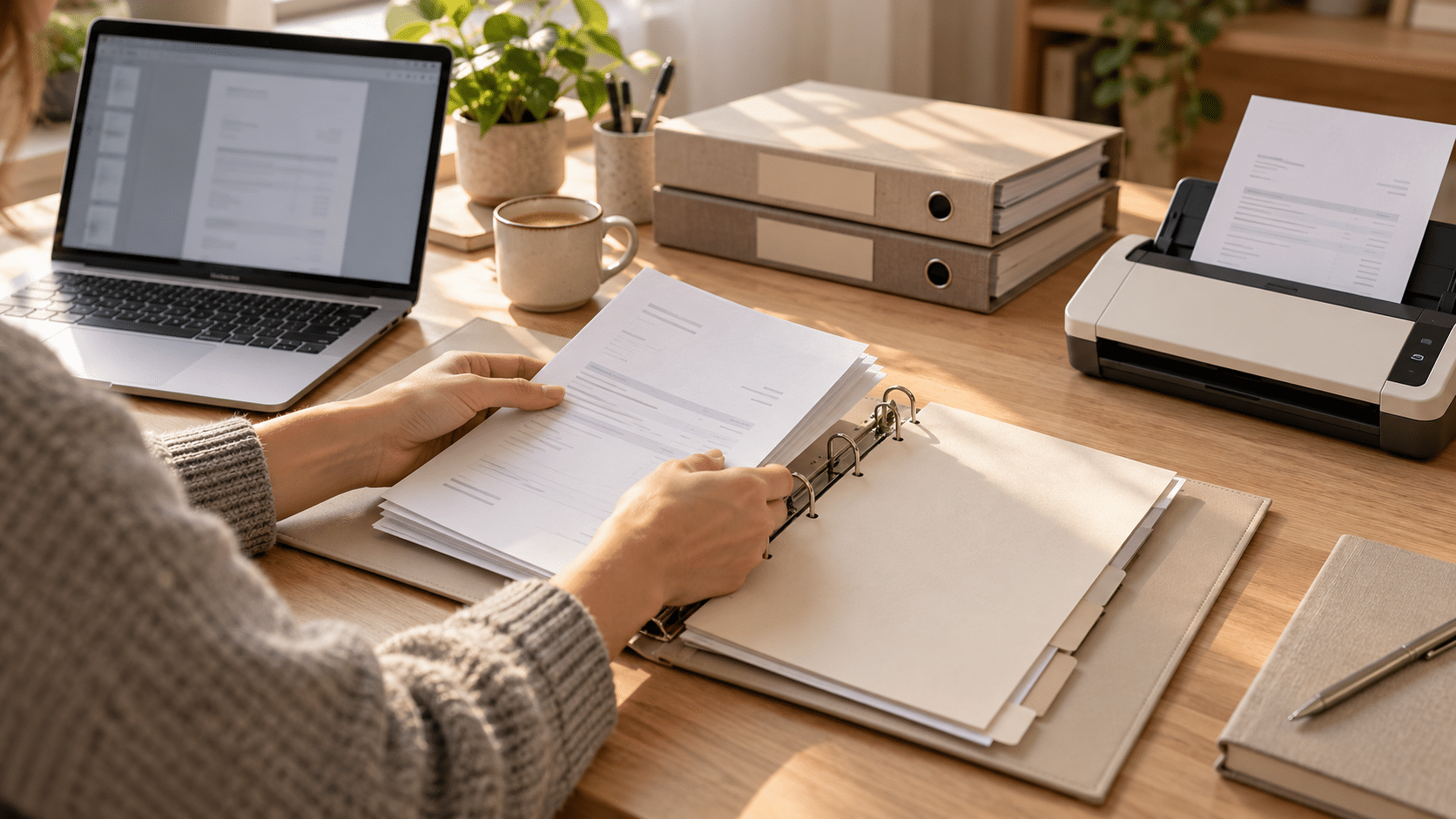
Keeping accounting records in Switzerland: retention periods and digital archiving
Scanning an invoice is useful, but does not by itself create a compliant archive. Your business must be able to retrieve its documents, link them to the underlying transactions and read them throughout the required retention period.

By Sarah Prieur · Swiss certified accountant
Key takeaways
The short answer
Accounting books, supporting documents, annual reports and audit reports must generally be kept for ten years after the end of the financial year. This rule is set out in Article 958f of the Swiss Code of Obligations (CO).
- Accounting books and supporting documents may be stored electronically if the applicable requirements are met.
- The CO requires a printed and signed copy of the annual report and audit report.
- Certain property-related VAT records must be kept for twenty years.
- A data backup and a retrievable archive serve different purposes.
Which accounting records should you keep for ten years?
The records you retain must explain your transactions and accounts: sales invoices, purchase invoices, credit notes, expense claims, bank statements, accounting entries, journals and relevant year-end working papers. Payroll records and the tax documents needed for your file also require consistent organisation.
The CO retention period starts at the end of the financial year. For a year ending on 31 December 2026, the ordinary ten-year period runs until the end of 2036. Do not automatically destroy the entire file on the following 1 January: first check for ongoing proceedings and any special rules.
Important contracts, ownership documents, capital transactions and evidence supporting long-term rights may need to be kept longer. The ten-year accounting rule is not a universal instruction to delete every document once that period ends.
Retention periods and exceptions: what to check
| Document or situation | Retention rule | What to watch |
|---|---|---|
| Accounting books and supporting documents | Ten years from the end of the financial year. | Keep the records traceable and readable throughout that period. |
| Annual report and audit report | Ten years; retain a printed and signed copy as required by the CO. | An unsigned file alone is not sufficient. |
| Ordinary VAT records | Until the absolute limitation period expires: ten years from the end of the relevant tax period (Articles 42(6) and 70(2) of the VAT Act). | Article 958f CO also remains applicable; the starting dates may differ. |
| Records needed for property-related VAT adjustments | Twenty years under Article 70(3) of the VAT Act, and longer if the absolute limitation period for the relevant tax claim has not expired. | Keep the cost records and history of use needed for the calculations. |
| Ongoing dispute or investigation | Retention must reflect the requirements of the case. | Suspend destruction of the relevant documents. |
The twenty-year period does not apply indiscriminately to every invoice issued or received by a property business. It covers the documents needed to calculate own-use VAT adjustments or subsequent input tax relief relating to immovable property. These adjustments can arise when the use of a property changes. The end of twenty years is therefore not always the date when records can be destroyed: the Federal Tax Administration explains that retention continues if the relevant absolute limitation period has not expired (source in French).
Can digital files replace the paper originals?
Article 958f CO allows accounting books and supporting documents to be retained electronically if their connection to the transactions remains reliable and they can still be read. The Swiss ordinance on keeping and retaining accounting records, known as Olico in French and GeBüV in German, sets out the organisational and integrity requirements.
A scan must be complete, legible and correctly linked to the file. A cropped image, an unreadable receipt or a file without a reference does not meet that practical need simply because it exists on a drive.
Before destroying an original, also check whether it has a particular legal value or is subject to a rule requiring its retention. The printed and signed reports required by the CO, certain title documents and original contractual documents cannot automatically be treated like an ordinary till receipt.
PDF/A can help preserve long-term readability, but the format alone does not guarantee the integrity of the entire archiving system.
For company expenses, also keep the information that explains their business purpose. Our article on tax-deductible expenses for a Swiss LLC or corporation explains the supporting evidence useful for different types of expenditure.
What makes a reliable digital archive?
Article 3 of the accounting records ordinance requires any alteration of a record to remain detectable. Archives must also be protected, organised and accessible to authorised people within a reasonable time. A shared folder in which anyone can replace a PDF without leaving a trace does not, by itself, meet these requirements.
Cloud storage is possible, subject to conditions
For modifiable storage media, Article 9 of the ordinance requires additional safeguards:
- a technical process that protects the integrity of the information;
- verifiable evidence of when the information was recorded that cannot be falsified;
- compliance with the requirements applicable to the process used;
- documented procedures and retention of the necessary protocols and logs.
Electronic signatures and timestamps are examples of technical measures, not a reason to skip reviewing the complete system. Ask your provider how these safeguards work, how access is logged and how you can retrieve the archive when the contract ends. A PDF/A file supports long-term readability; it does not make a cloud folder compliant on its own.
Keep a clear trail from the document to the accounting entry
- Capture: retain the complete document and any relevant attachments.
- Organise: assign an identifier linked to the accounting entry and separate archived records from working files.
- Protect: restrict access, log consultations and make changes detectable.
- Document: appoint a responsible person and retain working instructions and required logs.
- Test: regularly check integrity, readability and the ability to retrieve records.
A backup allows data to be restored after an incident. An archive preserves evidence for the full retention period. A rolling backup that overwrites older versions is therefore not a substitute for an archive.
Changing accounting software without losing your history
Before cancelling a software subscription, export the journals, general ledgers, trial balances, annual accounts and supporting documents, together with the links between them. A balance sheet export alone will not allow you to reconstruct the accounts.
Check the export format, whether documents can be read without an active subscription, access rights and any retrieval costs. Test an older period: finding an invoice from its accounting entry is a useful practical check. Under Article 10 of the ordinance, a migration must preserve information that is complete, accurate, available and readable. A record of the transfer must be retained with the data. Note the date, tools used, files transferred and checks performed before closing access to the old system.
Your accounting firm may keep a working copy, but your business must ensure lasting access to the records for which it is responsible. When changing accountants, include the handover of supporting documents and exports in the transition schedule.
The accounting cycle does not end when the financial statements are produced: it also includes preserving the evidence behind them.
Prepare for an audit without rebuilding the whole file
A complete year-end accounting file includes the approved accounts, closing entries, bank reconciliations, VAT returns, import documents and explanations of unusual transactions. Add an index that lets someone trace a reported figure back to its supporting document.
For a Swiss VAT audit, reconciling sales, VAT returns and supporting documents is particularly useful. A large archive that cannot be searched can create as many difficulties as an incomplete file.
Assign responsibility for archiving and document the destruction procedure. Check retention periods by document type and keep a record of what was destroyed, after reviewing the exceptions.
My advice
Once a year, ask someone who did not work on the file to retrieve three older supporting documents from the corresponding accounting entries. If they cannot find them quickly, improve the indexing before scanning more paperwork or switching tools.
Build an archive you can actually use
Before discarding paper or cancelling software, check three things: the right retention period for each file, evidence of its integrity and the ability to read it again. Start with an older financial year and address any gaps before extending the approach to all your records.
Further reading
- Year-end accounting in Switzerland: preparing a complete file
- Keeping accounts in Switzerland: obligations and practical benefits
- VAT audits in Switzerland: preparation, process and follow-up
Need a professional review of your records?
The Karpeo team helps you connect these rules to your figures and your business obligations. Explore our online accounting support.
Talk to Karpeo →Frequently asked questions
Does the ten-year period start on the invoice date?
The accounting retention period under Article 958f CO starts at the end of the financial year. Additional periods may apply depending on the document and the circumstances.
Can I scan the documents and throw away all the paper?
No. You must ensure the archive meets the applicable requirements and check whether particular originals must be retained. The printed and signed reports required by the CO still need to be dealt with separately.
Is a backup of the accounting software enough?
Not necessarily. You must be able to read and retrieve both the accounting data and the supporting documents throughout the retention period, including after changing software or ending a subscription.
Do some records have to be kept for twenty years?
Yes. Article 70(3) of the VAT Act covers the documents needed to calculate own-use VAT adjustments or subsequent input tax relief relating to immovable property. Longer retention may be necessary if the absolute limitation period for the relevant tax claim has not expired. This period does not apply to every invoice.
Official sources and references
Sources checked on 6 October 2026. The example of a financial year ending on 31 December 2026 illustrates the ordinary period, subject to the exceptions explained above.
- Code of Obligations, Article 958f — retention periods, storage media and signed reports
- Accounting records ordinance (Olico/GeBüV), Articles 3–10 — integrity, access, storage and migration (French)
- Swiss federal SME Portal — electronic bookkeeping and retention
- Federal Tax Administration — retention periods, audit trails and electronic invoices (French)
- VAT Act (LTVA), Articles 42 and 70 — limitation periods and record retention (French)
About the author
Sarah Prieur
Sarah Prieur is a Swiss certified accountant, partner and head of operations at Karpeo. She supports SMEs, self-employed professionals and entrepreneurs with accounting and taxation, and oversees the quality of client files. Before Karpeo, she spent eight years in audit at PwC Switzerland, progressing to manager.
Discover Sarah’s background →